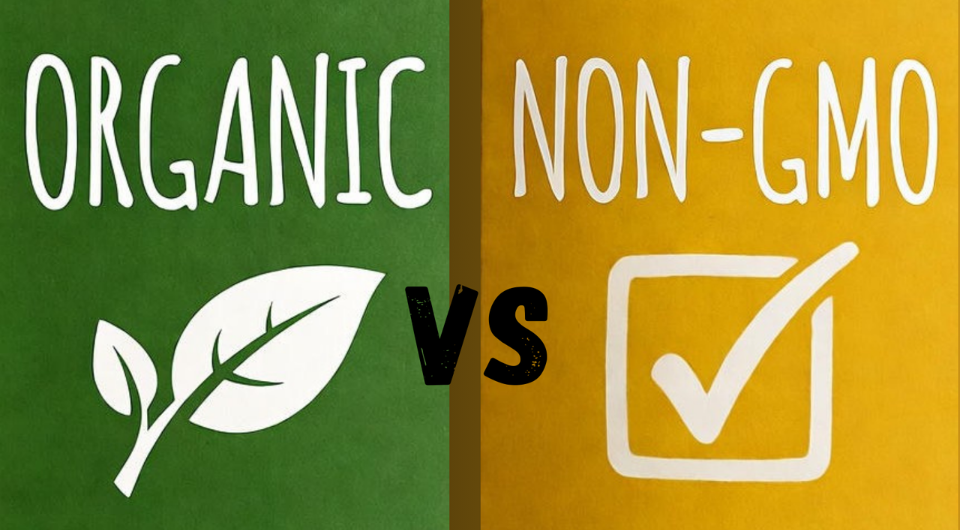
Are you confused by “Organic” vs. “Non-GMO” labels in the grocery store? Most people are. The labels look similar, cost more and feel like the “better” choice, but they mean very different things.
Here’s the clear breakdown you need to shop with confidence.
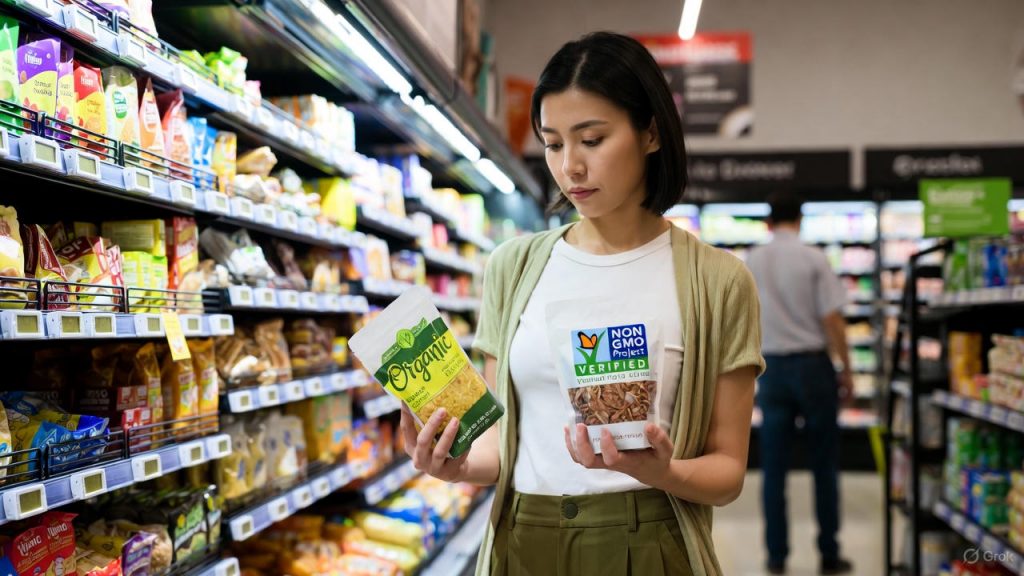
You’re standing in the grocery aisle, holding two nearly identical boxes of cereal. One bears a cheerful butterfly seal that says “Non-GMO Project Verified.” The other displays the familiar green-and-white “USDA Organic” circle. Both promise something better, cleaner, more trustworthy. You’ve heard the buzzwords, natural, pure, sustainable, but in this quiet moment of decision, a nagging question surfaces: What am I actually buying?
For millions of shoppers, this scene plays out weekly. We’ve been trained to look for labels that signal safety and ethics, yet the very symbols meant to clarify have become a source of profound confusion. The organic and non-GMO movements emerged from separate dreams. One about holistic farming in harmony with nature, the other about genetic transparency in an age of scientific intervention. But in the marketplace, they’ve collided, merged and sometimes been weaponized by marketing, leaving us to navigate a labyrinth where the most important truths are often hidden in the fine print.
This isn’t just about personal choice. It’s about a broken conversation between eaters and growers, between science and storytelling, between what happens on a farm and what ends up on a shelf. The labels we trust or distrust, shape billion-dollar industries, influence global trade and reflect our deepest anxieties about health, environment and control. To understand them is to pull back the curtain on one of the most consequential debates of our time: Who gets to decide what’s in our food and how much are we willing to pay for the illusion of certainty?
Two Labels, Two Entirely Different Stories
Let’s start with the basics, because this is where the confusion begins. “Organic” and “Non-GMO” are not synonyms. They aren’t even cousins. They are fundamentally different answers to different questions.
Organic certification, whether under the USDA in the United States or the EU’s comprehensive system in Europe, is a holistic promise. It’s about process. When you buy organic, you’re buying into a farming philosophy that prohibits synthetic pesticides and fertilizers, says no to antibiotics and growth hormones in livestock and bans practices like irradiation and the use of sewage sludge. In the EU, the rules go even further, requiring the farm’s location on the label and embedding animal welfare ideals directly into the regulation. It’s a way of farming that aims to work with nature, not against it. And yes, a core part of that promise is the prohibition of genetically modified organisms. If it’s certified organic, it is, by definition, supposed to be non-GMO.
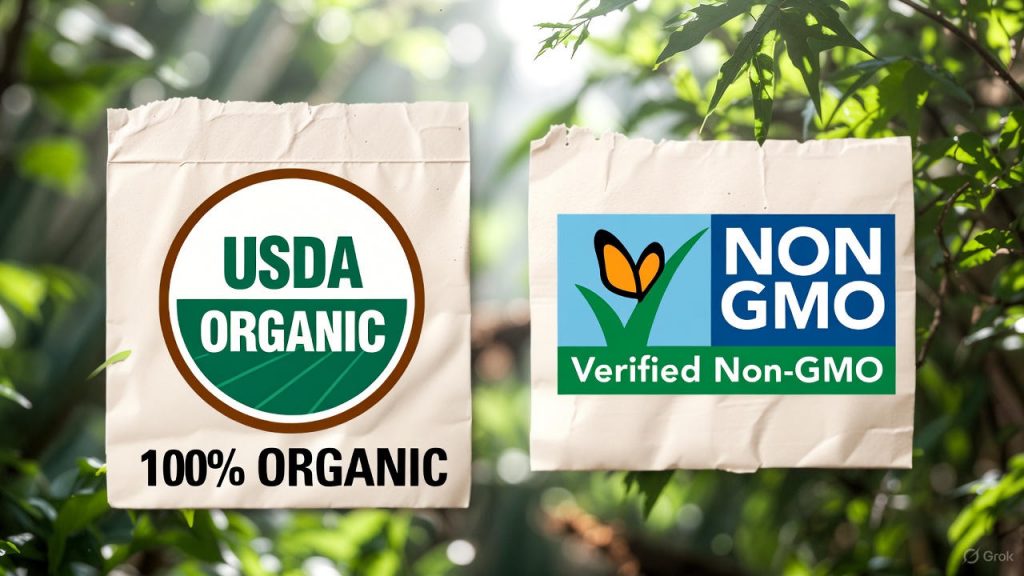
Now, look at the Non-GMO label, most commonly the blue-and-orange butterfly from the Non-GMO Project. This label asks and answers one specific question: Does this product contain genetically modified ingredients? It’s a product-based standard, focused on genetic integrity at the endpoint. Here’s the critical part: A product can be Non-GMO Project Verified and still be grown with a cocktail of synthetic pesticides, herbicides and fertilizers. It can come from animals routinely given antibiotics or raised in confined conditions. The butterfly says nothing about those practices. It is a laser-focused guarantee about what is not in the genes, not a broad promise about how the food was brought to life.
This distinction isn’t a minor technicality. It’s the heart of the issue. One label (organic) is a story about the journey. The other (non-GMO) is a story about a single chapter. And in the crowded narrative of the supermarket, we often mistake one for the other.
The Trust Gap and the Rise of the Butterfly
Why did the Non-GMO Project’s butterfly take flight in the first place, especially in a country where organic standards already ban GMOs? The answer lies in a profound crisis of trust and a regulatory gap.
In the United States, the first major GMO crops hit the market in the mid-1990s with little public fanfare and no mandatory labeling. As their adoption exploded. Today, over 90% of U.S. corn, soy and cotton is genetically engineered. A segment of consumers grew uneasy. Was this food safe? What were the long-term environmental impacts? Who controlled the seeds? Scientific bodies like the National Academy of Sciences consistently found approved GMOs to be as safe as their conventional counterparts, but public perception often diverged from scientific consensus, fueled by information asymmetry and a healthy distrust of large agribusiness.
With the government not requiring clear labels, the market created its own solution. The Non-GMO Project, founded in 2007, stepped into this void. It offered a rigorous, third-party verification system for companies that wanted to prove their ingredients were not genetically engineered. It wasn’t claiming products were “GMO-free” (a legal impossibility due to risks of cross-contamination) but “Verified” to contain less than 0.9% GMO material for high-risk ingredients. For consumers desperate for a signal they could understand, the butterfly became a beacon of transparency in a murky landscape.
This movement reached a tipping point when retailers like Whole Foods Market announced in 2013 that they would require GMO labeling for all products in their stores by 2018. This corporate mandate, which preceded the U.S. government’s own bioengineered food disclosure law, supercharged the Non-GMO label from a niche concern to a mainstream market force. Suddenly, the butterfly wasn’t just for activists; it was for anyone shopping at a popular grocery chain. It filled a trust gap that official organic certification, for all its breadth, hadn’t fully addressed for consumers singularly focused on genetic modification.
A Tale of Two Continents: How the EU Does Things Differently
Cross the Atlantic and the label landscape shifts dramatically. In the European Union, the standalone Non-GMO butterfly is a much rarer sight. Why? Because the EU tackled the GMO question head-on with strict, mandatory regulation.
The EU’s approach is grounded in the “precautionary principle”. The idea that if an action or product risks causing harm, in the absence of scientific consensus, the burden of proof falls on those taking the action. This led to one of the world’s most stringent GMO regulatory frameworks. Any food product containing more than 0.9% of approved GMO ingredients must be clearly labeled. Furthermore, the EU’s organic regulation (EC No 834/2007) explicitly prohibits the use of GMOs and sets the same 0.9% threshold for accidental, adventitious presence.
The result is a more integrated system. For an EU consumer, buying organic inherently means buying non-GMO. The EU Organic logo. A green leaf made of stars, bundles those promises together. There’s less need for a separate, private verification because the public standard is perceived as robust and trustworthy. The label must even show the farm’s location, adding a layer of traceability that U.S. labels lack. This difference highlights a cultural divergence: in Europe, food safety and transparency are often seen as a public regulatory responsibility; in the U.S., they have frequently been left to the private sector and consumer choice, leading to a proliferation of competing labels and claims.
The Hidden Cost of Our Choices
Behind every label is an economic reality. Organic and Non-GMO products command significant premiums. The global organic food market is hurtling toward a valuation of $770 billion by 2030, while the Non-GMO Project alone verifies products representing over $43 billion in annual sales. Consumers vote with their wallets, showing a willingness to pay 25-30% more for non-GMO labels and often even higher premiums for organic.
But this creates a stark social implication: a two-tiered food system. The choice to buy verified, cleaner food becomes a privilege largely accessible to those with higher incomes. This raises difficult questions about equity and access. Are we building a future where the healthiest, most ethically produced food is a luxury good?
The economic ripple effects extend to farmers. Transitioning to organic certification is a costly, multi-year process with real financial risk, though it can lead to higher prices for crops. Adopting GMO seeds, conversely, can offer yield benefits and pest resistance but often locks farmers into purchasing proprietary seeds and specific chemical packages from a handful of large companies, impacting farm sovereignty and long-term sustainability. Our label preferences in the grocery store directly influence which of these agricultural models thrives.
Greenwashing and the “Natural” Mirage
Into this already complex mix steps the most misleading term of all: “Natural.” Walk down any aisle and you’ll see it plastered on everything from chips to soda. In the U.S., this term has no legal definition from the FDA for food labeling. It is a marketing free-for-all. A product labeled “natural” or “GMO-free” (without a verification seal) could be grown with a heavy dose of synthetic pesticides and still legally make that claim. This is greenwashing in its purest form, using vague, feel-good language to imply health and environmental benefits that don’t exist.
This practice exploits the very confusion this article seeks to dispel. It preys on shoppers who are trying to do the right thing but lack the time or tools to decode the packaging. It turns the supermarket into a minefield of misinformation, where the loudest, most appealing claim is often the least substantive. The lesson is clear: trust the seal, not the slogan. The USDA Organic seal and the Non-GMO Project Verified butterfly represent audited, third-party verification. The word “natural” represents a marketing department’s opinion.
The Future of Food Labels: Gene Editing, Blockchain and Beyond
The story of food labels is far from over. We are on the cusp of changes that will make today’s debates seem simple. The next frontier is gene editing, technologies like CRISPR-Cas9 that can precisely edit a plant’s own DNA without inserting foreign genes. Regulators worldwide are scrambling to decide: Is this a GMO? The EU is currently reviewing its strict stance, while other countries may create entirely new categories for “precision-bred” organisms. This could shatter our current definitions of “non-GMO” and force a rewrite of the rulebook.
At the same time, technology promises new levels of transparency. Blockchain systems, like IBM’s Food Trust, could allow you to scan a QR code and see an immutable record of your food’s journey from seed to shelf, verifying organic practices or non-GMO status with unprecedented certainty. This could be the ultimate weapon against fraud and greenwashing.
We’re also seeing the rise of labels that go “beyond organic,” like “regenerative agriculture,” which focuses on soil health and carbon sequestration. These emerging terms may eventually reshape the market, offering a new tier of environmental promise. As the science evolves and consumer values shift, the labels on our food will continue to be a living document of our collective anxieties, hopes and understanding of what it means to eat well.
Conclusion
So, the next time you find yourself in that grocery aisle, pause. Look past the colors and the butterflies and the comforting words. See the labels for what they are: not just stamps of approval but fragments of a much larger story about science, trust, economics and ethics. The organic seal tells a tale of holistic care for the land and animals. The non-GMO butterfly speaks to a desire for genetic transparency and a cautious approach to biotechnology. Neither is inherently ‘better’; they are tools for different values.
Perhaps the most important label is the one we create for ourselves: that of an informed eater. In a world eager to sell us simplicity, our power lies in embracing complexity, in understanding that the journey to better food isn’t about finding a single perfect logo but about asking better questions. Who grew this? How were they treated? What is this label promising and what is it carefully not saying? Our carts, in the end, are not just collections of groceries. They are ballots. And with a little knowledge, we can cast them for a food system that is not only safer and cleaner but truly more honest.
References
- The Meaning of the Organic Label in the US vs. EU
- Decoding Organic vs. Non-GMO Labels
- Organic vs. Natural vs. Non-GMO & More: The ULTIMATE Guide to Deciphering Food Labels
- What’s the Difference Between Non-GMO and Organic?
- The Difference Between USDA Organic and Non-GMO Verified Seal
- Akerlof, G. A. (1970). The Market for “Lemons”: Quality Uncertainty and the Market Mechanism. The Quarterly Journal of Economics, 84(3), 488–500.
- European Commission. (2020). EU Organic Farming Action Plan. Retrieved from https://ec.europa.eu/agriculture/organic/eu-policy/action-plan_en
- Grand View Research. (2023). Organic Food & Beverages Market Size, Share & Trends Analysis Report, 2023 – 2030. Retrieved from https://www.grandviewresearch.com/industry-analysis/organic-food-beverage-market
- Non-GMO Project. (2023). Non-GMO Project Standard. Retrieved from https://www.nongmoproject.org/product-verification/non-gmo-project-standard/
- Non-GMO Project. (2023). Our Impact. Retrieved from https://www.nongmoproject.org/about/our-impact/
- Organic Trade Association. (2023). 2023 Organic Industry Survey. Retrieved from https://ota.com/organic-market-info/organic-industry-survey
- Shiva, V. (2016). Stolen Harvest: The Hijacking of the Global Food Supply. University Press of Kentucky.
- USDA Economic Research Service (ERS). (2023). Recent Trends in GE Adoption. Retrieved from https://www.ers.usda.gov/data-products/adoption-of-genetically-engineered-crops-in-the-u-s/recent-trends-in-ge-adoption/
- USDA National Organic Program (NOP). (2023). About the National Organic Program. Retrieved from https://www.ams.usda.gov/about-ams/programs-offices/national-organic-program
- Whole Foods Market. (2013, March 8). Whole Foods Market to Require GMO Labeling on All Products in U.S. and Canadian Stores by 2018. Press Release. Retrieved from https://media.wholefoodsmarket.com/news/whole-foods-market-to-require-gmo-labeling-on-all-products-in-u-s-and-canadian-stores-by-2018
About The Author: Imandi
More posts by Imandi